Posts

The Larger Context Translation Market

Image
This is another post inspired by my recent visit to Rio and dialogue at the ABRATES conference, where translators were eager to engage with MT in a meaningful way, and asked many questions about where the most interesting translation challenges were. In several conversations about “the translation market” I had a very clear sense of how there really needs to be a larger perspective on what this means, as the most interesting opportunities with MT tend to lie outside what is generally understood as the translation industry.  For most of the people who attend “translation industry” and localization conferences, the most trusted description of the industry is the market that Common Sense Advisory (CSA) describes as the Language Services Market . A market where translation agencies provide translation, localization and interpreting services to buyers for a fee. This is a market that is estimated by CSA to be $38.16 Billion in 2015, with Lionbridge proudly claiming ...

The ABRATES Conference in Rio: Translators focusing on MT

Image
I had the honor of participating in the 7th ABRATES International Translation and Interpreting Conference in Rio de Janeiro last week. An event that had over 500 attendees, based on my casual observation. A large portion of the attendees were translators, but there were also some LSPs and Enterprise representatives. As much of the information was presented in Portuguese I had direct experience with simultaneous translation via a headset which was also kind of cool, and it was fun to switch around when I was less interested in the actual subject matter. The formidable, emotion packed sign language interpretation by Paloma Bueno, intensely focused simultaneous interpreter volunteers in the booth, and the abounding loveliness of Rio. I found the conference surprisingly refreshing for several reasons including: The high level of understanding that many translators had about MT, Post-Editing practice and their general attitude that i...

The Concept of MT Maturity

Image
I would like to introduce a series of posts that looks at and discusses the concept of MT Maturity. I hope to illustrate that getting real business advantage from MT requires alignment with a variety of other related business processes. I also plan to look at how the MT technology continues to evolve, especially as related to use in professional translation and corporate use to make large amounts of content multilingual.  To facilitate the discussion I have created my own very rough evaluation and analysis model, which is an adaptation of the CSA Localization Maturity Model which is an adaptation of the software industry’s capability maturity model (CMM). Basically, it is a way of assessing if the technology user understands the technology, and is also using it in an efficient and effective manner by properly linking it to other organizational processes.  Thus, companies that are at a higher stage of the CSA LMM model referenced above, will tend to have much ...

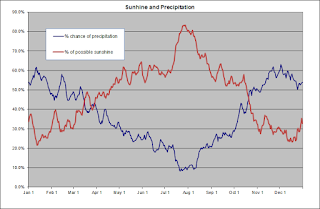
What's the chance of rain and the likelihood of sunshine throughout the year in Victoria?

Image
The chart below shows the % chance of precipitation and the % of possible sunshine on any given day during the year in Victoria.  It's really striking how the likelihood of precipitation and sunshine form a mirror image of each other. Let's start by looking at the blue line - the chance of precipitation on any given day.  This starts in the 50-60% range during January and February, drops below 50% in March, and gradually declines until it reaches about 20% in June and early July.  Then we see something that is very distinctive of the climate in our area - a sharp drop down to about a 10% chance of rain on any given day from roughly the second week of July until mid-August.  That's definitely the time to plan your camping trip or outdoor event if you want to almost guarantee dry weather!  Beginning in mid-August, the chance of rain begins to increase, back to about 20% by the end of August, then gradually increases to about 25% by the end of September.  Unli...

How often does it snow in Victoria?

Image
It's been a while since we saw a scene like this (from 2006) in Victoria - four years, in fact! The last time there was more than 1 cm of snow on the ground in Victoria was January 20, 2012 – four years ago tomorrow, and there’s a good chance that we will make it through the rest of this winter without snow.  Even by Victoria standards, that’s an unusually long snowless stretch.  In fact, it’s the longest snowless stretch since they began recording snow depth at Victoria Gonzales in 1955.  The second longest stretch was from February 20, 1986 to February 15, 1989 – just short of three years.    How often does it snow in Victoria?  That’s a question that residents and non-residents frequently ask, and I have heard a lot of different answers.  Some people may think it never snows in Victoria, while others will claim it snows every winter.  I already talked about the general patterns for snow in Victoria in an earlier post , but I thought I would dig...

The Sunniest Month in Canadian History

Image
I've already mentioned that Victoria is the sunniest place in B.C. and one of the sunniest cities in Canada.  Well, here's some more proof of just how sunny it is here.  I came across the following list of the sunniest months ever recorded in Canada.  (This is based on Environment Canada measurements from all ten provinces, but doesn't include locations in the territories  since some northern locations get 24 hour daylight in June and July.)  Amazingly, while the statistics came from hundreds of weather sites across Canada, Victoria Gonzales or Victoria Airport accounted for 5 of the 8 sunniest months on record, including the top 4 sunniest months ever recorded in Canada: Station Month Hours 1 Victoria Airport July 2013 432.8 2 Victoria Gonzales July 1985 426.0 3 Victoria Gonzales July 1958 424.7 4 Victoria Airport July 1985 421.5 5 Manyberries, AB July 1985 414.0 6 Cranbrook, BC July 1985 413.0 ...

A nice rain shadow yesterday

Image
I've mentioned how the Olympic Mountain rain shadow has such a profound impact on Victoria's climate.  Thanks to this effect, the Victoria Gonzales weather station averages only 641 mm of precipitation annually, compared  more than 1000 mm in Metchosin (20 km west) and more than 3500 mm at Port Renfrew (80 km west on the exposed southwest coast of Vancouver Island). Yesterday, we had a good example of a rain shadow.  Here's what the radar looked like around midday yesterday: You can see there is a pretty clear hole in the rain over Victoria, as well as the northeast Olympic Peninsula.  That "hole" persisted for most of the day and there were only a couple of light sprinkles.  Meanwhile, there was steady rain all day up at the Victoria Airport, with rain recorded every hour from 4 am until midnight yesterday. The precipitation totals from yesterday also tell the story.  There was just 1.4 mm of rain at Victoria Gonzales and 1.5 mm of rain at the University o...